Report by Arif Maulana
Translation by Alifya Rofi

[unpad.ac.id, 08/10/2020] Chewing is among the habits that people in Southeast Asia often practice. Even though it is believed to be good for maintaining dental health, the habit of beteling is closely related to the onset of oral cancer and pre-cancer.
Lecturer at the Unpad Faculty of Dentistry, Elizabeth Fitriana Sari, drg., Sp.PM., conducted a detailed study of the chemical composition of the betel quid package which is often used by Indonesians.
Generally, betel packages contain alkaloids such as arecoline. These compounds are often associated as carcinogens or substances that can cause cancer.
“There have been many studies investigating the betel component. However, there is no detailed research on the chemical composition of the chewing package, especially the chewing package from Indonesia,” said the lecturer who is familiarly called Fitri.
The doctoral candidate at the Melbourne Dental School University of Melbourne, Australia conducted joint research with a number of other researchers, including Grace Puspita Prayogo, Yit Tao Loo, Pangzhen Zhang, Michael John McCullough, and Nicola Cirillo.
The sample packages used generally contain areca nut (Arecha Catechu), betel leaf or betel stem inflorescence of Piper betel, and slaked lime.
The studied samples came from four different regions in Indonesia, namely Aceh, North Sumatra, West Kalimantan, and West Papua. In these four locations, the tradition of chewing has been carried out from generation to generation.
Fitri said the study was carried out by examining in detail the antioxidant activity of the betel package components through the total phenolic content (TPC) test, ferric reducing antioxidant power (FRAP), and radical scavenging activity (DPPH test).
In addition, Fitri and her team identified the levels of polyphenolic and arecoline contained in almost all components of the betel package, such as areca nut (betel nut), betel leaf or betel stem inflorescence (betel flower), husk (areca nutshell). The identification process used high-performance Liquid Chromatography-Mass Spectrometry (LC-MS).
“We also saw changes in the chemical composition when it was in the form of a mixture of areca nut, betel leaf or betel flower, and lime,” he said.
The results showed that the TPC, FRAP, and DPPH test scores were high in all the betel nut samples. Betel nuts from West Papua had the highest concentration among the other samples.
Identification results using LC-MS also showed that the outer shell of the areca nut (husk) was rich in various types of polyphenols, including hydroxybenzoic acids, hydroxycinnamic acids, flavanols, flavonols, and stilbenes.
Catechins and epicatechin were found as polyphenols with the highest concentration derived from West Papua betel nuts. Meanwhile, arecoline could be detected in all betel nut samples and mixed betel packages from four regions.
“There is a significant correlation between arecoline and catechin and epicatechin, and significantly negative with P-hydroxybenzoic acid. We also proved that the arecoline concentration changes significantly when areca seeds are mixed with lime and betel leaf or betel flower,” said Fitri.
The degree of maturity of betel nuts is also directly related to the number of polyphenols and arecoline. Unripe betel nuts contain higher concentrations of polyphenols and arecoline than ripe ones.
“The suggestion is that consuming ripe betel nuts can reduce the potential for developing oral submucous fibrosis (a pre-cancer of the mouth due to betel nut) and also oral cancer,” said Fitri.
In short, the results of studies conducted by Fitri and the team regarding the chemical composition of different betel packets in Indonesia can inform the development of chemo-preventive strategies to differentiate the development of oral submucous fibrosis.
“For example, consuming mature betel nuts, avoiding husks because of their high arecoline content, and not adding slaked lime, can reduce the potential for developing oral submucous fibrosis in betel chewers,” he concluded.
Earn Achievement
The research entitled “Distinct Phenolic, Alkaloid and Antioxidant Profile in Betel Quids from Four Regions of Indonesia” has been published in the international journal Nature Research Journals, on October 1st.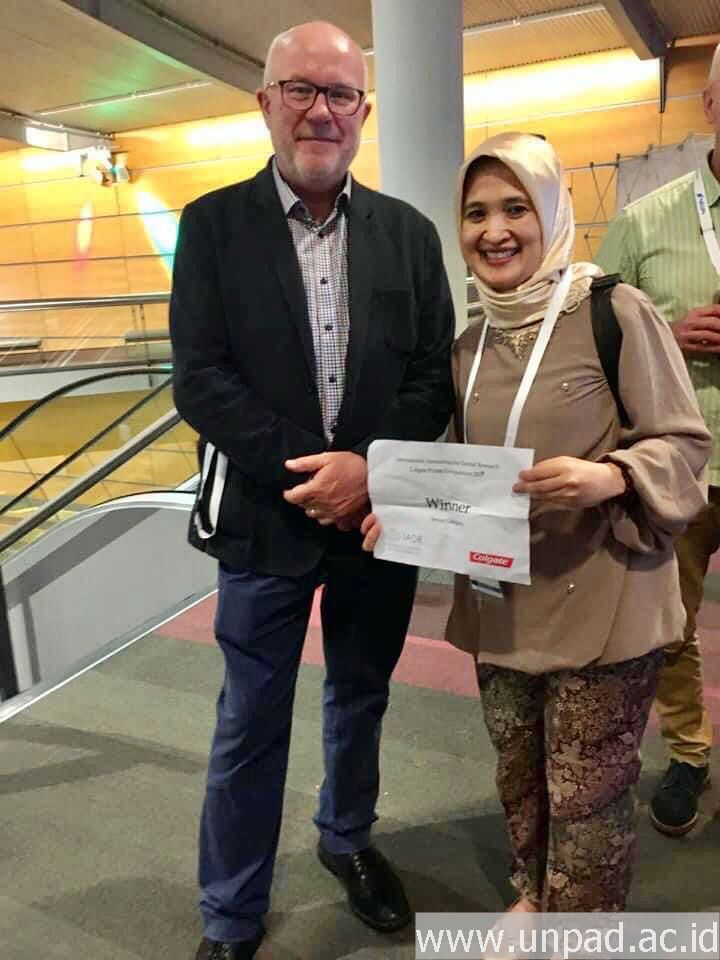
In addition, Fitri continued, this research has been competed at the Faculty level at Melbourne Dental School and received the “Colgate Travel” award to compete again at the International Association of Dental Research (IADR) meetings in the Asia Pacific, Australia, and New Zealand which are located in Brisbane, last November 2019.
“Alhamdulillah, we won 1st place for the Senior Category. And [we] plan to take part in a worldwide competition for the Hatton Award in Washington DC in March 2020, representing Indonesia and the Australia-New Zealand IADR divisional. However, due to the pandemic, the IADR meeting was canceled,” she said.*
Open access to Elizabeth Fitriana Sari’s article in the Nature journal can be found here.
You can read the original article in Indonesian here: