Report by Arif Maulana
Translation by Aura Hanifatus Saskia
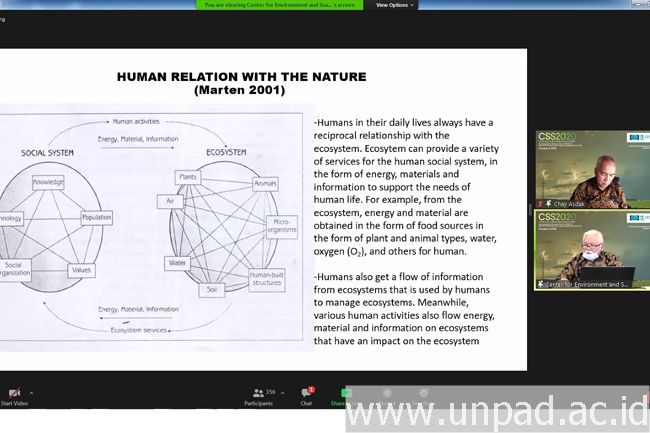
[unpad.ac.id, 08/10/2020] The emergence of the COVID-19 pandemic that has hit almost all countries on Earth is none other than the result of an imbalance between human activities and nature. Human-induced natural damage is one of the causes of the COVID-19 pandemic.
Professor of the Faculty of Mathematics and Natural Sciences of Universitas Padjadjaran, Prof. Johan Iskandar Ph.D., said that the phenomenon of the transmission of infectious diseases from animals as the primary reservoir to humans is precisely due to human activity. Humans are considered imprudent towards the environment.
“Forest encroachment, forest destruction, illegal hunting of wild animals, and animal trafficking are the causes,” said Prof. Johan when he presented as the keynote speaker at the Conference on Sustainability Science (CSS) 2020 which was held online, Thursday (08/10).
The Unpad ethnobiology expert explained that the COVID-19 pandemic is an example of the current massive transmission of viruses from animals to humans. The spread of SARS-Cov-2 that triggers COVID-19 is caused by the transmission.
It is known that bats are the main reservoir of the virus which was first revealed in Wuhan, China.
“The virus transmission was very fast, initially to animals, now it has spread to humans,” said Prof. Johan.
Unstoppable population growth coupled with economic growth has made dramatic changes in human interactions with the environment. Harmful interactions will encourage ecological disasters, one of which is the emergence of a pandemic.
In reality, humans used to have a close relationship with the environment. This can be seen from the activities of traditional communities in building relationships with the environment based on traditional ecological knowledge and beliefs.
From generation to generation, people protect nature through patterns or ecological values passed on by their ancestors. This can be seen from a number of traditions or ecological patterns that are maintained by the indigenous people in Kampung Naga in Tasikmalaya or the Kanekes/Baduy people in Banten.
Based on the studies that have been conducted by Prof. Johan, Kampung Naga has at least three environmental zones, namely the clean area (settlement), the dirty area (fish pond and bathing place), and the sacred area (protected area).
On the other hand, the Kanekes area itself is also divided into three areas, namely the first area (lembur/village and hamlet forest), the second area (huma, a land that has just been cleared of the forest for rice fields and reuma, a long-abandoned huma), and the third area (leuweung kolot/leuweung titipan/ancestral forest).
From this ecological pattern, it is concluded that traditional ecological knowledge has a role in maintaining environmental quality. “Human actions towards nature are carried out very carefully in the cultural adaptation system there,” said Prof. Johan.
Therefore, Prof. Johan hoped that global development progress must integrate economic, social, and environmental aspects.
This international conference was held in collaboration with the Unpad Center for Environment and Sustainability Science with The Greening of Industry Network. The conference, which was attended by hundreds of participants, also featured other speakers.*
You can read the original article in Indonesia here: https://www.unpad.ac.id/2020/10/pandemi-covid-19-cermin-hubungan-nirharmonis-manusia-dengan-alam/