Report by Arif Maulana
Translation by Aura Hanifatus Saskia
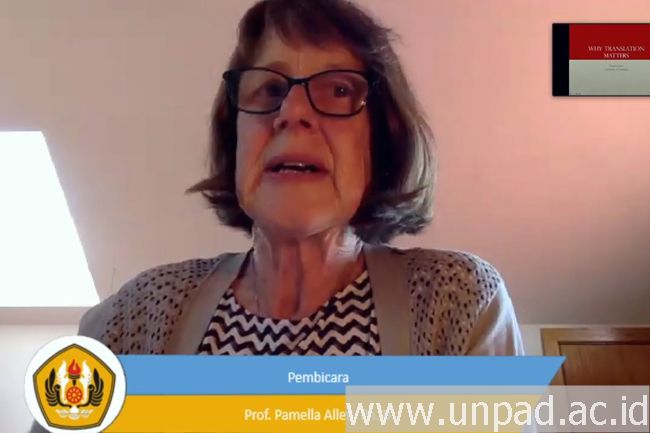
[unpad.ac.id, 03/11/2020] Literary works are not just fictions. Literature can be a medium for presenting the historical and social conditions of a nation to the outside world.
“Literary translation is an important key not only to unlock a country’s literary wealth, but also its history and socio-political reality,” said an Indonesianist from the University of Tasmania, Australia, Assoc. Prof. Pamela Allen, Ph.D., when delivering the scientific oration “Why Translation Matters” in the framework of the 62nd Anniversary of the Faculty of Humanities (FIB) Universitas Padjadjaran, Monday (02/11).
Since colonial times, many Indonesian authors have used sociopolitical realities as material for their work. This often drives authors, along with artists and journalists to become targets of censorship by authoritarian regimes.
Silencing the works does not necessarily kill the author’s imagination and creativity. The researcher of Indonesian language, literature, and studies said that authors must find ingenious and creative ways to incorporate social and political criticism into their work.
Furthermore, the academician who routinely translates Indonesian literary works into English explained that before the translation of Indonesian literary works was carried out, it was difficult for the outside community to know how Indonesia’s sociopolitical conditions were.
Indonesia is rich in history; however, the fact is not widely known at the international level. Therefore, the translation of Indonesian literary works can convey about Indonesia’s sociopolitical conditions to non-Indonesian readers.
“Literature and literary translation can be a window where we can see social reality; literature can speak to us more strongly than other forms of discourse,” said Allen.
Increase Synergy
The 62nd Anniversary Celebration of FIB Unpad was held online. On the occasion, the Rector of Unpad, Prof. Rina Indiastuti expressed her appreciation for the various achievements made by FIB Unpad.
“First, almost all study programs are accredited “A” by BAN PT. Insha Allah, several study programs of FIB Unpad have started to pioneer international accreditation,” said the Rector.
The Rector also appreciated the acquisition of study program development grants, research grants, as well as various achievements achieved by FIB Unpad students.
The study program at FIB Unpad is considered relevant in supporting the internationalization of Unpad. The expected profile of FIB graduates is to have great competence in mastering foreign languages.
For this reason, the Rector encouraged FIB to strengthen synergies with universities. The study program can be sharpened in order to have an international-standard study process.
The study curriculum at FIB must be oriented towards the learning outcomes. This orientation will produce graduates who have the competence and soft skills which follow the characteristics of the study program.
“With these competencies and skills, graduates will be quick to get hired or even create jobs,” said the Rector.
Apart from the curriculum, FIB Unpad is also encouraged to gain international recognition. “If international recognition has been obtained, the graduates will automatically be labeled with international quality standards,” said the Rector.*
You can read the original article in Indonesian here: https://www.unpad.ac.id/2020/11/dies-natalis-ke-62-fib-unpad-indonesianis-pamela-allen-bicara-pentingnya-penerjemahan-sastra/