Release: Unpad Faculty of Law (FH Unpad)
Translation by Winamora Dapa
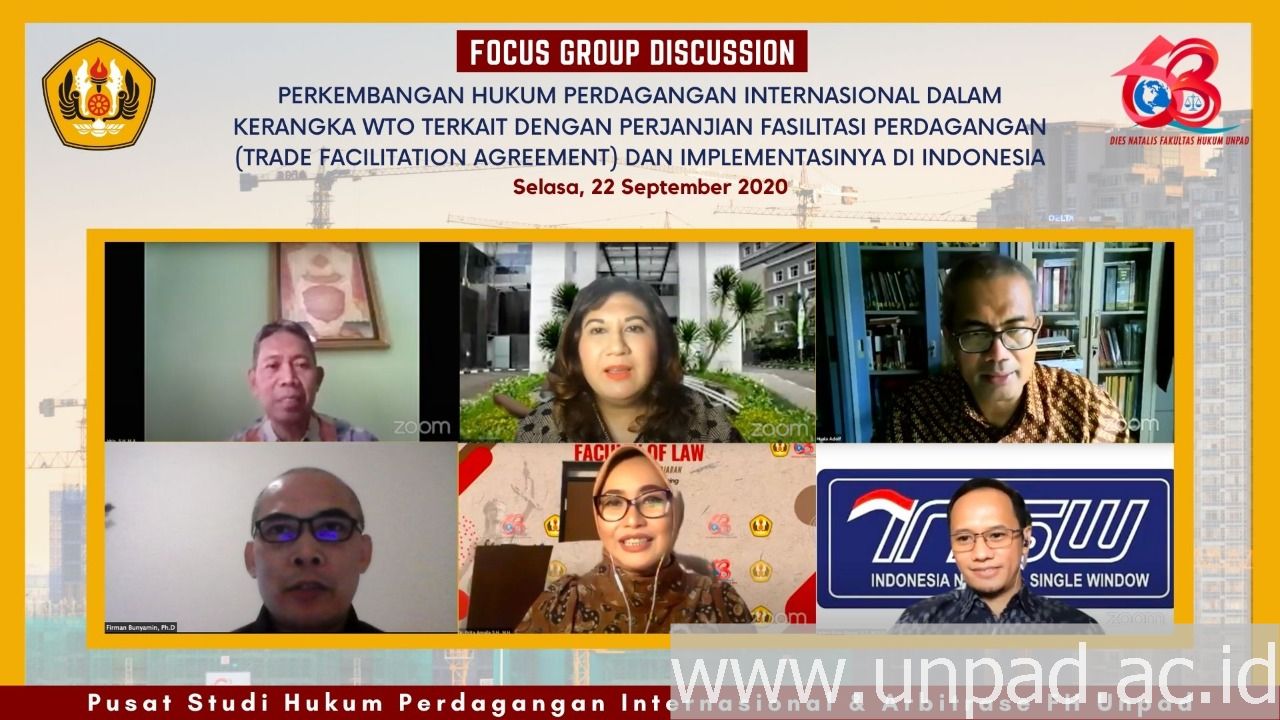
[unpad.ac.id, 30/09/2020] International Trade Law Research Center of Universitas Padjadjaran’s Faculty of Law held a virtual Focused Group Discussion (FGD) on Tuesday (22/09).
This discussion with the title “The Development of International Trade Law in WTO Context related to the Trade Facilitation Agreement and Its Implementation in Indonesia” was attended by a variety of speakers, from Unpad academics to government practitioners. The discussion was moderated by a lecturer from Unpad’s Faculty of Law (FH), Dr. Prita Amalia, M.H.
The first speaker, lecturer of FH Unpad, Dr. Idris, M.H., delivered his opinion regarding the Trade Facilitation Agreement from the perspective of the Vienna Convention on the Law of Treaties (VCLT), the year 1969.
Idris explained, based on the terms of VCLT Article 26, every international agreement that has been ratified will bind every party and must be fulfilled in good faith.
“As an international agreement that has been ratified by Indonesia through UU No. 17/2017 about the ratification of Protocol Amending the Marrakesh Agreement Establishing the World Trade Organization, then the Trade Facilitation Agreement has bind Indonesia, including the responsibility of this country to implement it,” said Idris.
The delegate of the Ministry of Trade, Republic of Indonesia, Franciska Simanjuntak, conveyed the opportunity and challenges for Indonesia post-ratification of the Trade Facilitation Agreement.
According to her, the Trade Facilitation Agreement is helpful in smoothing export and import flux, creating time and trade budget efficiency, increasing the country’s income and investment, even in encouraging the role of Micro Small and Medium Enterprises (UMKM) in exporting and increasing economic growth.
“Trade Facilitation Agreement also aims to create an effective trade collaboration, reducing the export-import obstacles, and offer technical help as well as capacity building for developing countries and least developed countries (LDC),” explained Franciska.
So far, the government of Indonesia is committed to implementing the terms in Category A of the Trade Facilitation Agreement. Throughout the implementation, Indonesia encountered a few challenges. Some of the challenges were the relatively high cost of the Trade Facilitation Agreement implementation, the need to revise and establish new regulations to adjust to the agreement terms, as well as challenges to increase the capacity of human resources, infrastructure, and the quality of technology.
The third speaker, Head of IV Bilateral Section, Directorate of International Customs and Inter-agency, Directorate General of Customs and Excise (DJBC), Firman Bunyamin, delivered materials related to the implementation of the Trade Facilitation Agreement and regulations of the Directorate General of Customs and Excise.
In line with the increasing export and import flux in Indonesia and the long process of managing the documents, it is hoped that the ratification of the Trade Facilitation Agreement can overcome these problems.
Firman expressed that Indonesia remains committed to implementing all Trade Facilitation Agreement regulations and [expected to be able to do it] optimally in 2022. The TFA is also expected to be an “evaluation” of the regulations in the DJBC. DJBC itself continues to develop customs regulations according to the agreement.
Furthermore, System Architect Manager, Subdirectorate of Information and Communication Technology Governance and System Design, Directorate of Quality Assurance, National Single Window (NSW), Fachry Rozy Oemar explained the NSW institution.
According to him, NSW is an association consisting of ministries and organizations whose function is to facilitate in terms of technology and procedures, so that business actors can compete well with their business partners in other countries.
“NSW unites all administrative matters, both import and export, in one door, so it is hoped that the bureaucratic flow will be shorter as one of WTO member countries’ commitment forms to ease the business flow,” said Fachry.
Last, Professor of Unpad Faculty of Law, who is also the Head of International Trade and Arbitration Law Studies Center, Prof. Huala Adolf, S.H, LL.M, Ph.D., delivered contents regarding the comparison in implementation of Trade Facilitation Agreements between several countries, particularly Malaysia, Thailand, and Vietnam. (arm)*
You can read the original article in Indonesian here:
https://www.unpad.ac.id/2020/09/fh-unpad-gelar-diskusi-seputar-trade-facilitation-agreement/